Bringing the Shop to the Field
How Mobile Service Capabilities Keep Catesa Farms Moving
For large-scale farming operations, productivity is measured in acres tilled and crops harvested. Every minute of downtime matters, especially during planting and harvest seasons, when weather windows are tight and equipment is expected to perform at its highest level at any time of day or night.
That reality is something Catesa Farms knows well.
Founded in 1927, the family-owned operation has spent nearly a century growing and evolving alongside Tennessee agriculture. Today, the farm spans approximately 9,000 acres across six counties, producing corn, soybeans, wheat, milo, strawberries and watermelons. George McDonald, whose great-grandfather started Catesa Farms, currently runs the operation.
Managing thousands of acres across multiple counties presents unique challenges, particularly when it comes to maintaining equipment. With fields stretching hours away from the farm's main property, transporting machinery back to a central shop for repairs or routine maintenance is often impractical.
"When you have a machine go down in the field, you can't necessarily haul it two hours back to the shop to work on it," says Kyle Cato, operations manager at Catesa Farms. "We have to bring our shop to the field."
The Challenge: Keeping Equipment Moving Across Six Counties
A service vehicle is nothing new for Catesa Farms, but purchasing a new mechanic truck in 2024 helped to bring their productivity into this century. Now the operation has a truck that is capable of bringing all the necessary tools, parts and resources directly to the machine. The result has been faster repairs, reduced transportation costs and more productive equipment hours.
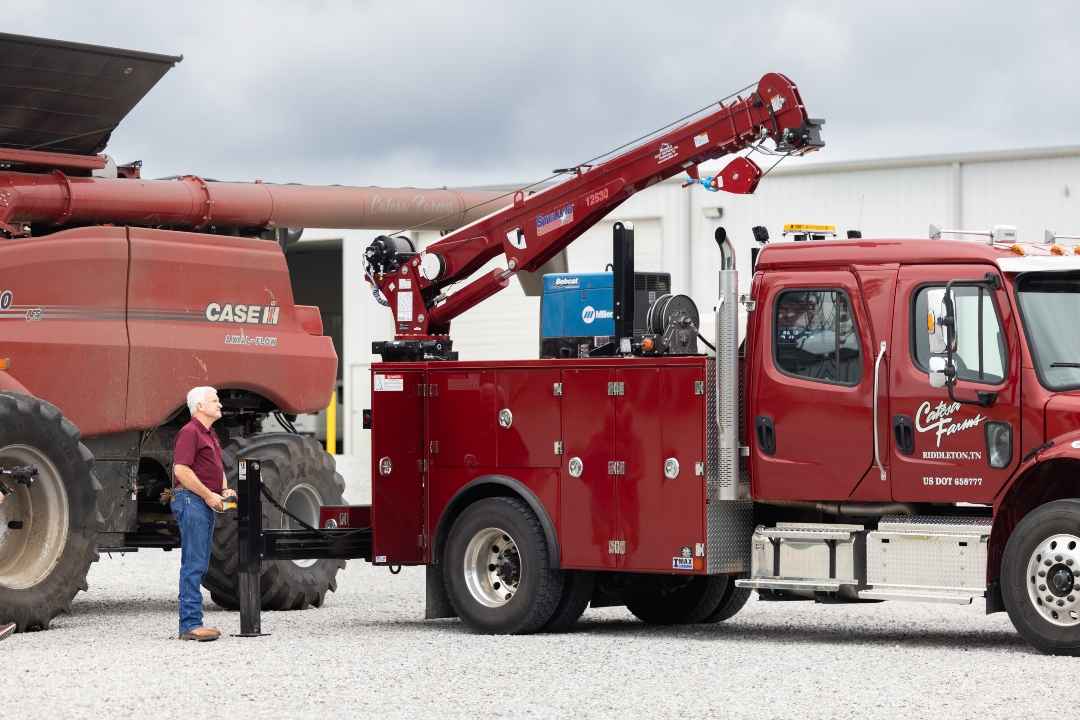
The mechanic truck in Catesa Farm’s fleet serves as a fully equipped mobile workspace, allowing the farm’s technicians to perform everything from preventative maintenance to major repairs without leaving the field.
"Now we have our shop in the field," says Cato. "It has the capacity to bring all the tools and lubricants necessary to repair equipment in the field."
Designing Around Real Farm Challenges
When McDonald and Cato set out to add a new mechanic truck to the Catesa Farms operation, their goal wasn’t simply to replace an existing service vehicle. They wanted to create a mobile maintenance platform capable of supporting equipment across their entire farm.
The team started by identifying the challenges they faced most often in the field. Equipment breakdowns rarely happen close to the shop, and transporting machines long distances for repairs can consume valuable time during critical planting and harvest windows. The truck needed to give technicians the ability to respond quickly, carry the tools and resources they needed and handle a wide range of maintenance and repair tasks.
With all of that in mind, a custom build made the most sense.
Built for Capability & Efficiency
One of the first decisions centered on finding the right balance between carrying capacity and overall efficiency. The team selected a larger truck platform that could support the equipment and tools required for field service while still maintaining a comfortable ride for whoever was driving.
Weight also became an important consideration. By choosing an aluminum body, Catesa Farms was able to maximize payload capacity while minimizing concerns about corrosion.
“Once we started building the truck, we saw that an aluminum body would lessen the weight,” said McDonald.
The result is a truck capable of carrying the tools, parts and equipment necessary without sacrificing overall durability or performance.
Staying Productive in the Field
Beyond material used for construction and overall comfort, the truck was designed to function as a true mobile workspace. Organized storage, onboard power and compressed air capabilities allow technicians to complete repairs and maintenance tasks wherever equipment is located.
Rather than making repeated trips back to the shop for tools, batteries or support equipment, technicians can stay focused on the repair at hand and get equipment back to working condition more quickly.
“Every morning, we’re greasing, we’re blowing off equipment with leaf blowers and now we have a power bank in there where we’re able to charge all the batteries,” said Cato. “We’re able to carry multiple battery-powered tools with us and not worry about losing charge.”
These capabilities may seem simple, but they help eliminate many of the small inefficiencies that can add up over the course of a busy season.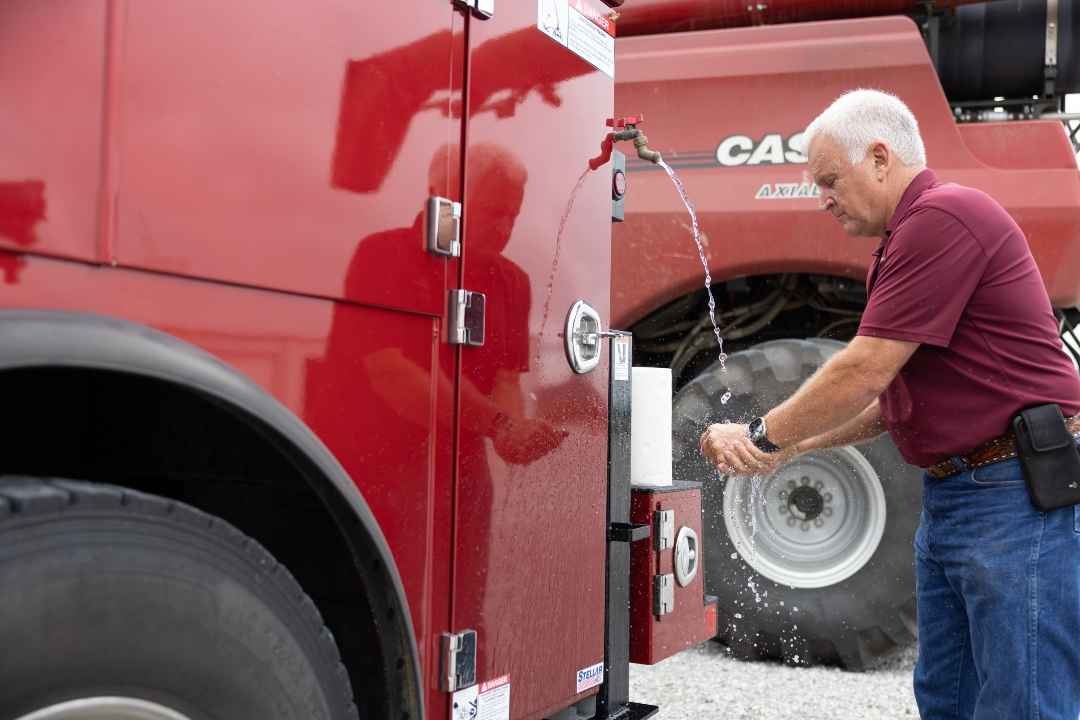
Handling Heavy Materials
For large farming operations, mobile maintenance isn’t just about routine service. It’s also about having the ability to safely handle larger, more complex repairs when equipment breaks down far from the shop.
The truck’s lifting capabilities allow technicians to remove heavy components, service combines and move large parts directly in the field. Instead of arranging additional equipment or transporting machinery elsewhere, many repairs can be completed where the breakdown occurs.
“On a large ag operation, when you have breakdowns or need to remove wheels off combines in the field or move heavy parts like augers, we’re able to use the crane,” says Cato. “Our combine heads weigh 10,000 pounds and we can move them safely with the crane.”
For Catesa Farms, that capability translates directly into reduced downtime and greater operational flexibility during the busiest times of the year.
Small Features Make a Big Difference
Catesa Farms really thought about every detail when it came to the investment in their mechanic truck, even the seemingly smaller details, such as adding a fresh water tank. After servicing equipment, technicians frequently need a place to wash grease and dirt from their hands. Water can also be used to clean windows, rinse components or serve as an emergency eye-flushing resource when working with dust, debris or fluids.
Though basic in concept, the convenience and practicality quickly become evident during everyday use, and it’s one of McDonald’s favorite features of the truck.
“One of our employees commented to me that he thought, ‘Why would you want to spend that kind of money on a service truck?’” says McDonald. “Now he says, ‘It’s one of the best things you’ve ever bought. I don’t know how we’d function without it.’”
A Truck That Does More
What began as a practical solution to a maintenance challenge has become an essential part of the farm's operational strategy. The truck not only supports equipment repairs but also helps maximize the effectiveness of the people performing them.
As farms, such as Catesa Farms, continue to expand and equipment grows more sophisticated, mobile service capabilities are becoming less of a luxury and more of a necessity. The introduction of a mechanic truck to a farming operation can help make sure those critical hours in the field are maximized, and equipment continues to run in its optimal state.
For Catesa Farms, an investment in a quality mechanic truck has delivered something every farming operation values: more time in the field, less downtime due to equipment repairs and greater confidence that equipment will be ready when it is needed most.